Apple's Record Quarter Meets a Looming Memory Chip Crisis
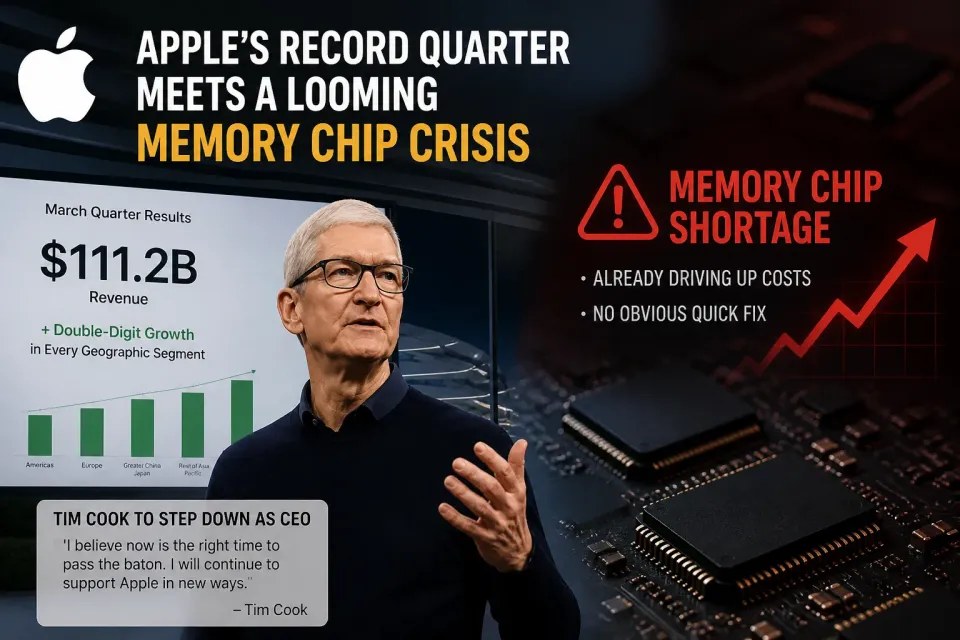
Apple's best March quarter on record landed on the same day Tim Cook announced he is stepping down. The two facts are worth holding together. The headline number — $111.2 billion in revenue, double-digit growth across every geographic segment — is genuinely strong. But Cook used the earnings call to flag something that will outlast his tenure: a memory chip shortage that is already pushing up Apple's costs and has no obvious quick fix.
The quarter itself
Revenue of $111.2 billion set a new March-quarter record. iPhone drove most of it, with demand for the iPhone 17 lineup described as "extraordinary" by Cook. Every geographic segment grew. On the surface, this is about as clean a result as a hardware company can report.
The wrinkle is in the cost structure. Apple spent more on memory chips in Q2 than in previous quarters. It partially offset that by drawing down stockpiled inventory, which kept margins from taking the full hit. That stockpile will not last indefinitely.
What RAMageddon actually means
"RAMageddon" is the shorthand circulating for a supply squeeze driven by the AI industry's appetite for high-bandwidth memory. Data center operators and AI chip makers are competing for the same memory components that go into consumer devices. That competition has pushed prices up sharply — reports put the increase in RAM costs for iPhone production at roughly four times previous levels.
This is not an Apple-specific problem, but Apple is particularly exposed because hardware is its core business. A meaningful increase in component costs either compresses margins or gets passed to buyers. Cook put it plainly on the earnings call, warning of "significantly higher memory costs" in June and beyond that may "drive an increasing impact" on the business. Asked separately by Reuters, he noted there is "just a little less flexibility in the supply chain at the moment."
How long the shortage persists depends largely on how quickly memory manufacturers can expand capacity to serve both AI and consumer markets — which is not something Apple controls.
The leadership handover
Cook will step down as CEO on September 1, transitioning to executive chairman. John Ternus, currently SVP of Hardware Engineering, takes over as CEO.
Ternus is a credible choice for a hardware-first company. He has led Apple's chip development efforts, including the transition to Apple Silicon, which gave the company meaningful control over its processor supply. His background is deeply technical, and the problems sitting on his desk — component costs, supply chain constraints — are ones he has been working around for years in his current role.
On Thursday's call, Ternus called Cook "one of the greatest business leaders of all time" and acknowledged the significance of the handover. Cook will remain as executive chairman, which means Ternus will have access to the supply chain expertise Cook built over 25 years — including the relationships with suppliers and contract manufacturers that underpin Apple's production model.
What higher memory costs could mean for iPhone prices
The most immediate practical question is whether Apple raises iPhone prices to protect margins. Some analysts have floated that possibility. Apple has historically been reluctant to raise sticker prices on core iPhone models, partly because price increases at the high end carry real demand risk. But quadrupled RAM costs are not a rounding error.
The Q2 stockpile draw suggests Apple anticipated some of this and prepared. Whether that preparation extends into Q3 and Q4 is unclear from what Cook disclosed. The June quarter guidance will be the next concrete data point.
What I still need to add
When I looked at Apple's Q2 cost-of-revenue line against previous March quarters, did the margin movement match what Cook described, or did the stockpile draw obscure more than the call let on?
What to watch next
Several things remain genuinely uncertain. How quickly memory manufacturers scale production will determine whether the shortage is a two-quarter problem or something longer. Apple's Q3 guidance will show whether the stockpile strategy bought enough time or whether margin pressure is already visible in the numbers. And Ternus's first public moves as CEO — on pricing, on supply deals, on product decisions — will say something about whether Apple's hardware discipline holds under new management.
The record quarter is real. So is the problem Cook handed off.