How Agent Memory Architectures Actually Work
A stateless LLM forgets everything the moment a session ends, no matter how capable it is. It can't build relationships, learn from mistakes, or carry expertise across tasks. That's why agent memory is the defining engineering problem of 2026 — the agentic AI vector database market is projected to grow from $2.3 billion in 2025 to $18.7 billion by 2036, per a Fact.MR forecast.
The gap between a demo agent and a production agent comes down to memory. Get it right, and the agent remembers what happened across sessions. Get it wrong, and you have an expensive chatbot that re-reads the same documents every call.
TL;DR
- Agent memory splits into four types: working (in-context), episodic (past conversations), semantic (facts and knowledge), and procedural (learned skills). Each needs a different storage backend.
- A dedicated memory layer uses roughly 6,956 tokens per retrieval vs. ~26,000 when dumping data into a full context window. That's a massive cost difference at scale (Mem0, July 2026).
- The Model Context Protocol (MCP) hit 97 million SDK downloads in just 16 months, becoming the standard interface for connecting agents to external memory stores.
- Pure vector stores degrade at scale. The industry is consolidating around hybrid vector-graph architectures for reliable long-term context.
- Up to 82% of public MCP servers carry exploitable security flaws. Poisoned memory in a vector store is a direct path to prompt injection (Practical DevSecOps, June 2026).
What Are the Four Types of Agent Memory?
Agent memory maps onto cognitive science. Zylos Research (April 2026) identifies four types production agents need to manage, each with its own storage approach.
Working Memory: The Context Window
Working memory is whatever fits in the LLM's active context window right now. It's fast and needs no retrieval infrastructure, but it's expensive and resets to zero every session.
Expanding the context window to solve memory hits a cost ceiling fast. Full-context recall uses around 26,000 tokens per retrieval call, versus 6,956 tokens for a dedicated memory layer (Mem0, July 2026), a real difference at production volume.
Episodic Memory: What Happened Before
Episodic memory stores the agent's history — past conversations, completed tasks, decisions made. It's a searchable journal the agent consults when a user returns.
Storage is typically a vector database or hybrid store. Conversation turns get embedded and indexed; retrieval is semantic, pulling relevant chunks rather than a linear transcript.
Semantic Memory: What the Agent Knows
Semantic memory holds factual knowledge: documentation, policies, domain expertise. This is the classic RAG use case, where the agent queries a knowledge base to ground answers in facts it wasn't trained on.
Vector stores shine here. Embed a corpus, index it, retrieve by semantic similarity at query time. Qdrant, Milvus, and ChromaDB all publish MCP server integrations for exactly this.
Procedural Memory: How to Do Things
Procedural memory encodes learned behavior: which tools to call, which workflows succeeded before, which error patterns to avoid. It's the hardest type to implement cleanly.
It typically lives as structured records in a relational database or knowledge graph, not a vector store. It answers "how," not "what," and a graph can represent sequences vector search can't.
How Does MCP Wire Agents to Their Memory Stores?
MCP is the layer that connects LLM agents to external memory, tools, and data sources through one standardized interface. By March 2026, MCP had reached 97 million combined monthly SDK downloads in just 16 months — the fastest-adopted AI infrastructure standard on record, per DDR Innova. React took roughly three years to hit the same number.
Before MCP, connecting five AI models to twenty tools could mean up to 100 custom integrations. With MCP, each tool publishes one server and each model implements one client: five models and twenty tools becomes 25 implementations.
Think of it as USB-C for AI: one port, any peripheral. A memory server on Qdrant, ChromaDB, or CockroachDB exposes a standard set of tools (search, store, delete), and the agent calls them without knowing what's behind the interface.
Stateless vs. Stateful: The Architecture Shift That Matters
The original MCP spec tied sessions to persistent transport connections. That was fine for local development but a problem for cloud deployment, since stateful connections need sticky sessions and state sync.
On August 5, 2026, Google Cloud and Hugging Face released the 2026-07-28 spec release candidate, removing transport-level session management. As Google's Kurtis Van Gent and Alan Blount put it: "The original protocol-level session model required persistent state, handshakes, and session pinning... To solve this, Google led the charge to decouple the protocol from stateful transport constraints."
MCP servers now run as stateless HTTP endpoints. Agent state lives in the external stores, not the protocol transport. That's what makes enterprise-scale agent memory tractable.
Why Are Pure Vector Stores No Longer Enough?
Vector databases dominated the first wave of agent memory — semantic similarity search is fast and intuitive. But as deployments scaled through 2025 and 2026, two structural limitations became impossible to ignore.
The Relational Blindness Problem
Vector stores find semantically similar content. They don't understand relationships between entities, temporal sequences, or logical dependencies. If your agent needs to know that "User A approved Task B, which triggered Workflow C, which produced Document D," a vector store can't represent that chain reliably. Cosine similarity has no concept of causality or sequence.
Knowledge graphs fill the gap: entities as nodes, relationships as typed edges, giving structured answers vector recall can't produce. Zylos Research found rapid industry consolidation toward hybrid vector-graph stores as the standard backend for agents that need both semantic recall and relational reasoning.
Quality Degradation at Scale
Semantic search quality degrades predictably as the vector index grows. With millions of embedded chunks, signal-to-noise drops, retrieved context gets less precise, and the agent gets more irrelevant material in its prompt, which hurts output quality and raises token costs at once.
The fixes: better chunking, metadata filtering to narrow the search space before similarity search runs, and hierarchical indexing: coarse summaries at one level, raw chunks at another.
What Does a Real Production Memory Stack Look Like?
A production memory stack isn't one database choice. It's a layered system where each layer does one job well.
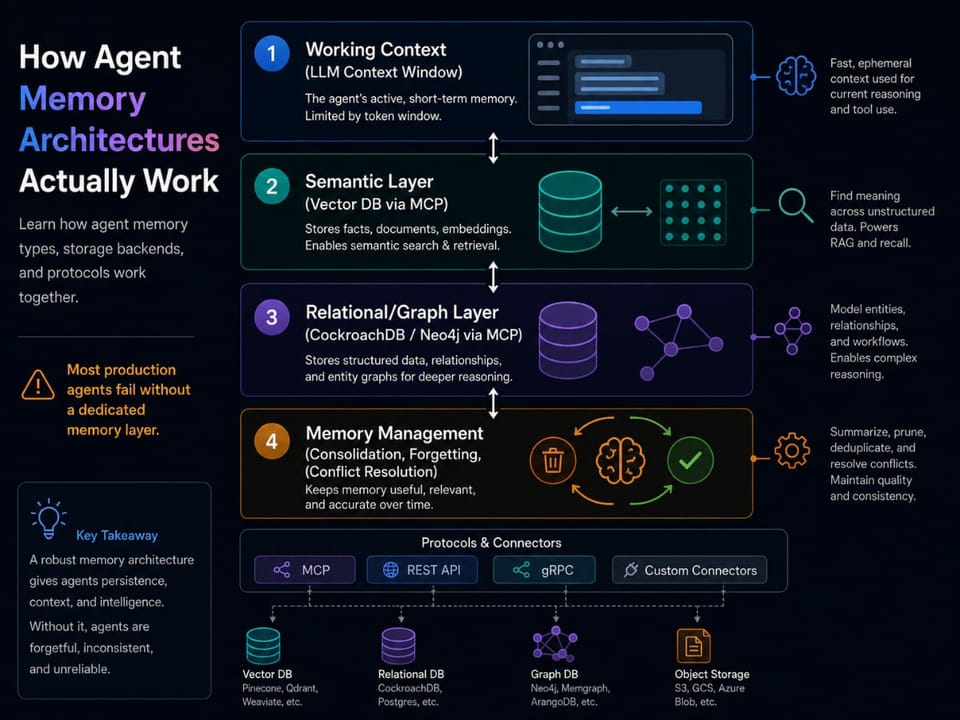
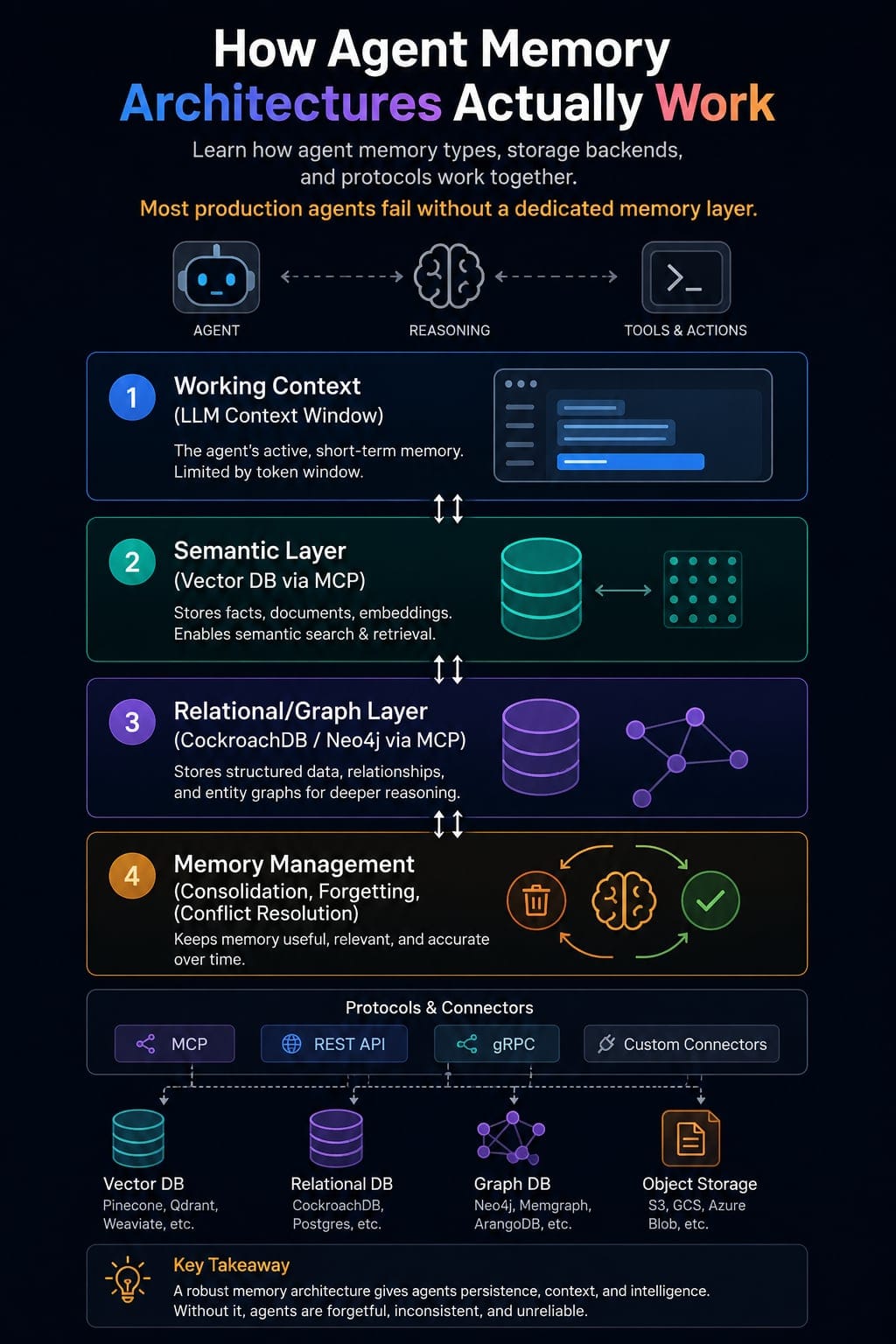
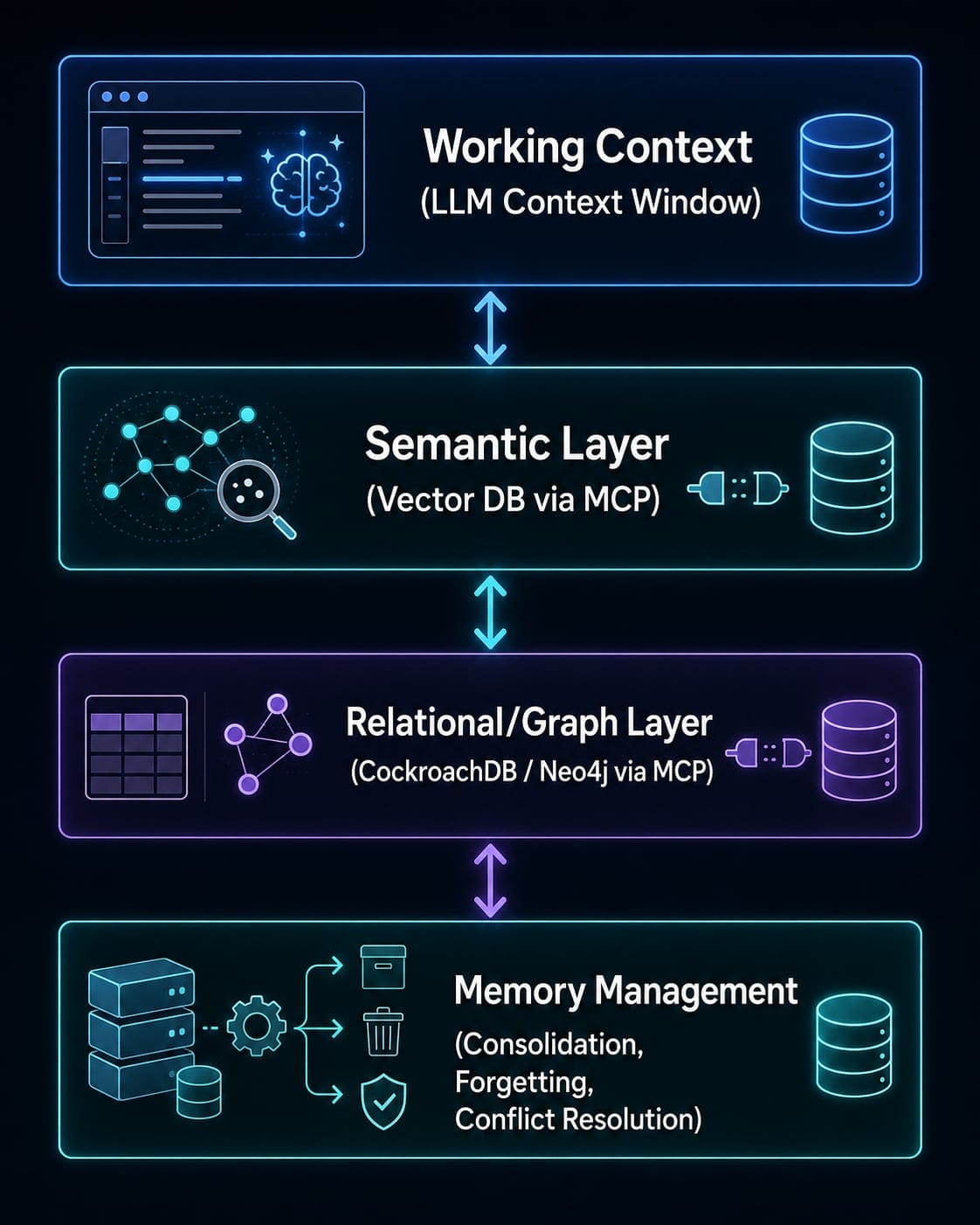
Layer 1: The Working Context
Keep the active context lean: the current task, the most recent turns, whatever the layers below retrieved. Inject only what's needed for this step.
Layer 2: The Semantic Retrieval Layer
A vector database (Qdrant, Milvus, ChromaDB, or pgvector on PostgreSQL) holds embeddings of episodic and semantic memory, queried through an MCP tool call. By May 2026, the GitHub tag mcp-server had hit 15,926 repositories.
Many teams are migrating to pgvector to cut cost: the argument is that vector search is a feature, not a business, and a Postgres extension delivers it without an extra managed service.
Layer 3: The Relational and Graph Layer
A relational database or knowledge graph stores structured state: user profiles, task histories, permissions. CockroachDB launched a fully managed MCP server in May 2026 for this. A graph layer, Neo4j or a lighter option like Kuzu, sits alongside it for relationship and temporal reasoning.
Layer 4: The Memory Management Layer
Raw storage isn't enough. You need consolidation, forgetting, and conflict resolution for contradictory information. Mem0 provides this orchestration layer as a managed service.
How Serious Are the Security Risks in Agent Memory Systems?
This is where most architecture discussions stop too soon — and where most incidents happen. Per Practical DevSecOps (June 2026), 30–82% of public MCP servers carry exploitable security flaws, and only 8.5% use OAuth.
The threat model: if an agent retrieves poisoned data from its vector store, that data lands in the LLM's context and gets processed as a trusted instruction. That's prompt injection via the memory layer, not the UI. HackerOne logged a 540% surge in agent-related prompt-injection reports over the same period.
The Three Attack Surfaces
Poisoned embeddings. An attacker who can write to your vector store, via a compromised pipeline or weak access controls, embeds adversarial instructions in plausible content. The agent retrieves it and executes the instruction.
Over-permissioned agents. Between 47% and 53% of organizations have seen agents exceed their permissions or suffer a security incident. Agents with write access can be manipulated into poisoning future retrievals.
Unauthenticated endpoints. With only 8.5% of servers using OAuth, an exposed MCP server is a direct read/write endpoint into your agent's memory.
Practical Mitigations
Sanitize every document before embedding it, the way you'd treat user input in a web form. Separate read and write access: most agents should read memory, few should write without a logged, explicit action. Scope permissions per agent and per user.
Conclusion
Agent memory isn't one database choice. It's an architecture across four memory types, several storage backends, a protocol layer, and a security posture that treats retrieved content as potentially hostile.
Start with working-memory discipline. Add persistent layers only when the stateless version breaks. The cost savings alone justify the investment.
FAQ
What is the difference between RAG and agent memory?
RAG retrieves relevant documents at inference time and grounds a response in them. Agent memory is broader — it includes RAG as the semantic layer, plus episodic memory, procedural memory, and working-memory management.
RAG typically serves one inference. Agent memory serves a workflow spanning hours or months, with write operations and state that evolves over time.
Is a Dedicated Memory Layer Cheaper Than a Big Context Window?
The Mem0 benchmark (July 2026) found a dedicated memory layer uses about 6,956 tokens per retrieval, versus roughly 26,000 for full-context recall: a 73% reduction.
At scale that compounds into real savings, though you still pay for the database, embedding calls, and engineering. For low-volume use, context-stuffing can still be cheaper, and the breakeven is typically hundreds to a few thousand daily sessions.
Can I use pgvector instead of a dedicated vector database?
Yes, and more teams are doing exactly that. pgvector adds vector similarity search to PostgreSQL, so you can combine semantic search with SQL filtering in one query.
The trade-off is scale: dedicated databases like Qdrant and Milvus outperform pgvector on very large indexes. For most deployments, though, pgvector on a well-provisioned Postgres instance is enough, and it removes a managed service from your stack.
What is MCP and why does it matter for agent memory specifically?
MCP is an open standard, created by Anthropic and now governed by the Linux Foundation, that defines how LLM agents connect to external tools, data, and memory stores.
Before MCP, connecting an agent to a vector database meant custom code per model and per database. MCP standardizes that: a memory store publishes tools like search, store, and delete, and any agent's MCP client can call them.
By March 2026, MCP had reached 97 million monthly SDK downloads, and by May 2026 there were more than 15,000 community-built MCP servers on GitHub. The August 2026 spec update made the protocol stateless at the transport level, which is what makes it viable for load-balanced cloud deployments.
How do I protect my agent's memory from prompt injection attacks?
Treat every external document as untrusted input: sanitize it before embedding, strip executable patterns, and log what gets stored.
Separate read and write access, scope memory per agent and per user, and apply OAuth or API-key auth to every MCP endpoint. Only 8.5% of public servers do this today, so you're already ahead of the field.
What is the hybrid vector-graph architecture and when should I use it?
It combines a vector database for semantic similarity with a knowledge graph for structured relationships: who approved what, what triggered what, in what order.
You need it when your agent must reason about sequences or entity relationships vector search can't represent. Zylos Research found rapid consolidation toward this hybrid model as the standard for episodic and procedural memory. Start with vector-only and add the graph layer once relational blindness causes real failures.